
< UNITED KINGDOM | LONDON: Mandarin Oriental Hyde Park London
1902
Mandarin Oriental
Hyde Park London
London
66 Knightsbridge
London SW1X 7LA
United Kingdom
Phone: +44 20 7235 2000
Fax: +44 20 7235 2001
www.mandarinoriental.com/london
Facebook | Twitter | Instagram
GPS: 51° 30' 7.6'' N 0° 9' 35.8'' W
MAKE A RESERVATION
powered by: Booking.com


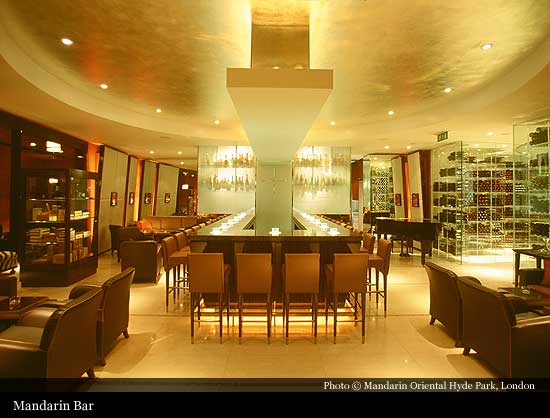

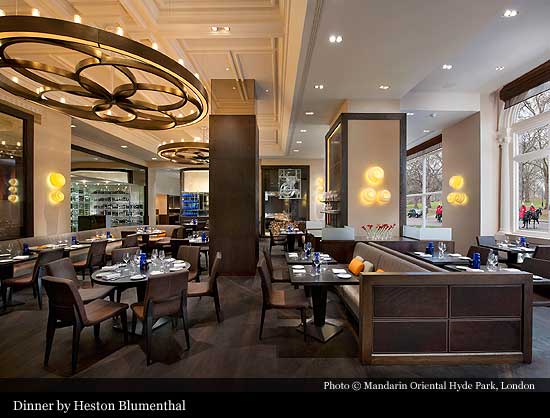


Overlooking London’s finest Royal Park on one side and cosmopolitan Knightsbridge on the other, the hotel was originally built in 1889 as an exclusive
‘Gentleman’s Club’ with lavishly furnished drawing and dining rooms, a billiard room and a smoking room.
The project, originally known as Hyde Park Court, was announced in August 1887 but was delayed by endless planning disagreements, the most notable dispute being the proposed
height of the development, which was to be the tallest building in London. Outraged residents feared a shadow would be cast over the Serpentine in Hyde Park and they
threatened to force the builders to reduce the number of floors by putting up a wooden barrier which would block the light to the lower floors. An unsuccessful Bill was
brought before parliament to reduce the restriction of buildings from 100 feet to 60 feet, and so the original design of the hotel remained.
Considerable skill was deployed in the creation of a dramatically picturesque skyline using red brick and Portland stone in an eclectic Franco-Flemish style. Loggias were
built to provide space for a pleasant summer’s evening lounge and promenade overlooking the park. Each of the first three floors was designed with four family suites and a
bachelor’s suite. The upper floors were planned as single residences of varying sizes. However, more than half the tenants occupied at least two or more suites, with a
certain dowager occupying six.
The palatial interior decoration, the lavish use of marbles and gilding were years ahead of the best London hotels. The hall, entered from Knightsbridge through swinging
doors of carved walnut, was lined with coloured marble and had a frescoed ceiling, as well as a marble chimneypiece complete with a marble clock. Stairs of white marble flanked
with balustrades led to the upper ground floor. This style of decoration continued in the principal communal rooms, including the breakfast and dining room overlooking Hyde Park.
In 1899, a dramatic fire struck the property. Watched by thousands, the fire damaged the top three floors of the Knightsbridge wing and destroyed part of the roof, including the
central iron and glass turret. All residents made a successful escape, despite the fire brigade’s ladders only reaching halfway up the building.
After the fire, and the necessary renovations, the building was reopened in 1902 as London’s newest and grandest hotel. The ceilings and marble floors had survived, and period
fireplaces in the style of Louis XV and XVI were installed, while the furnishings echoed the eighteenth century style of Sheraton and Hepplewhite.
Between 1911 and 1912 the Ballroom was redecorated in a style reminiscent of Louis XVI. In 1925, Mewes & Davis, who also remodelled some of the principle rooms in a traditional
Louis XV style, built a Palm Court.
As a private ‘Gentleman’s Club’ the entrance to this magnificent building was through The Loggia, but in 1902 when it re-opened as Hyde Park Hotel, the postal address had changed
from Albert Gate to 66 Knightsbridge. Tradition has it that the Queen would not allow any form of advertising within the Park, and therefore insisted that the main entrance,
with the hotel’s name above it, should be moved from the Park side to Knightsbridge and that the original entrance be preserved for Royal use alone, and has been opening for them
regularly ever since. These were first used during the coronation of George VI in 1937 when the Crown gave special permission for its guests to use the park entrance.
Today, guests can still take part in this grand tradition of the hotel by requesting permission from the Royal Parks to use the ‘Royal Entrance’ for special occasions. Guests who
have enjoyed access to this legendary entrance have included members of the Japanese Imperial family, former South African Premier General Hertzog and the President of Uganda,
to name just a few.
Spectacular parties that hold a special place in the hotel’s history include Lady Vyer’s silver wedding party in 1948 - with the King and Queen as guests of honour - and the
legendary Balaclava Ball, hosted by the five cavalry regiments who had taken part in the charge, attended by the Queen, Prince Philip and the late Queen Mother. Other celebrations
have included the 1992 production of “Pavarotti in the Park”, one of the country’s largest open-air concerts, the 1995 Anniversary of VE Day in which seven Heads of State and
their delegations took up residence and ‘Party in the Park’, one of the largest music events of 2005 where many of the top acts made Mandarin Oriental Hyde Park their home away
from home. Most recently, the hotel was proud to host the 80th birthday party of Baroness Thatcher which was attended by Prime Minister Tony Blair, Lord Archer, Shirley Bassey,
Joan Collins and John Major among others.
Mandarin Oriental Hotel Group purchased the Hyde Park Hotel in November 1996 and renamed it Mandarin Oriental Hyde Park, London. Following a £57 million restoration, it re-opened in May 2000.
Additional literature:
#Anthony Masters: Inside Marbled Halls: Life Above and Below Stairs in the Hyde Park Hotel
Sidgwick & Jackson Ltd, 1979 | ISBN-10: 0283984767; ISBN-13: 978-0283984761
English language | 232 pages | Hardcover
| Buy it at Amazon | Buy it at Alibris |